Home › Our System › The WRN Research Cycle
The WRN Research Cycle
A continuous cycle of inquiry, action and flourishing
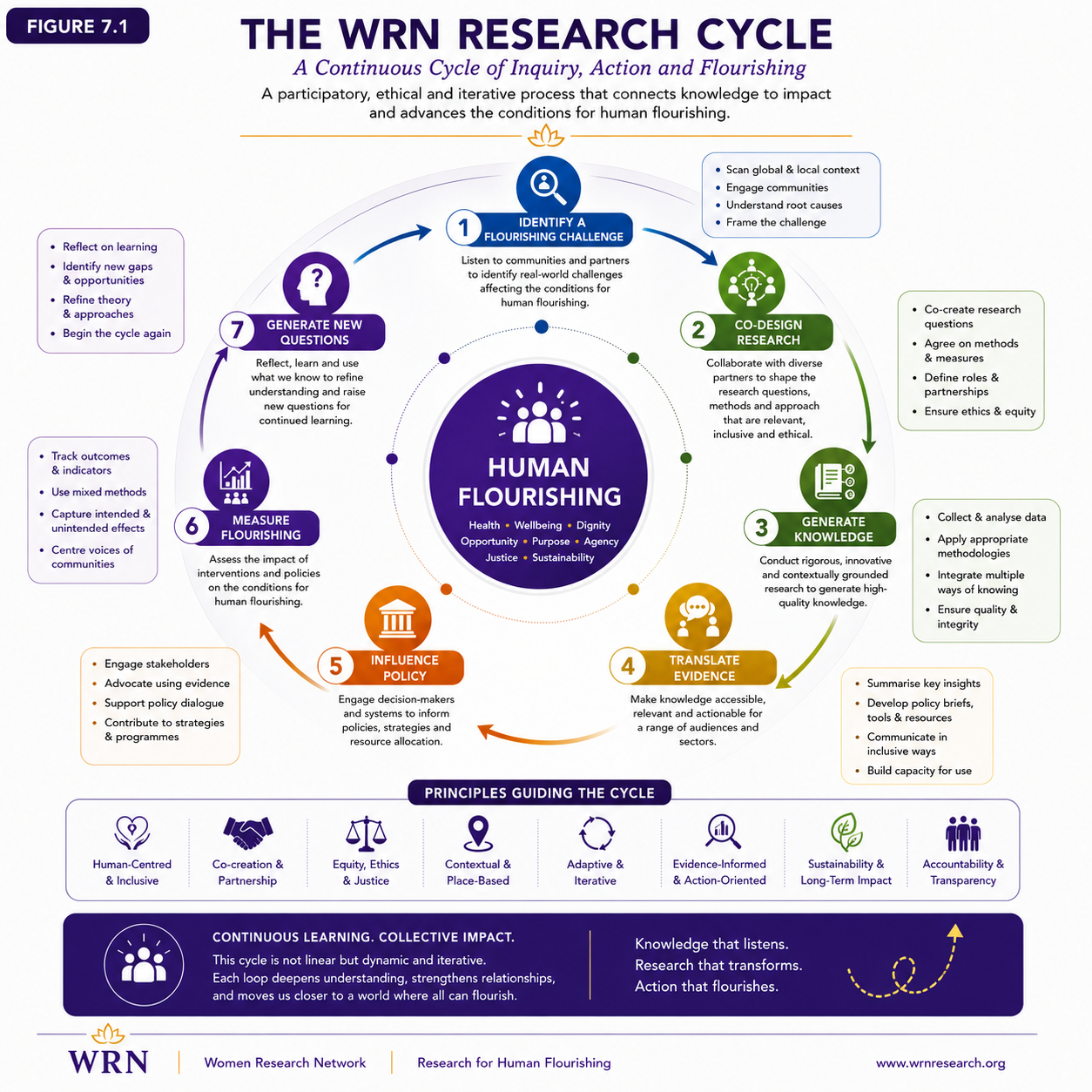
The WRN Research Cycle is a participatory, ethical and iterative process that connects knowledge to impact and advances the conditions for human flourishing. It is not a straight line — it is a living loop in which each stage deepens understanding, strengthens relationships and moves us closer to a world where all can flourish.
A continuous cycle of inquiry, action and flourishing
7
Cycle stages
8
Guiding principles
What is the The WRN Research Cycle?
The Research Cycle has seven stages, each with its own practices and disciplines. It begins by identifying a flourishing challenge — scanning context, engaging communities and framing the problem. It then moves through co-designing the research, generating knowledge, translating evidence, influencing policy and measuring flourishing, before generating new questions that begin the cycle again.
Eight principles guide the cycle throughout: it is Human-Centred & Inclusive; Co-creation & Partnership-based; grounded in Equity, Ethics & Justice; Contextual & Place-Based; Adaptive & Iterative; Evidence-Informed & Action-Oriented; committed to Sustainability & Long-Term Impact; and held to Accountability & Transparency.
The cycle is continuous and collective. Each turn deepens learning, strengthens relationships and moves us closer to flourishing. No stage is ever complete — it loops, learns and grows.
The WRN Research Cycle
 View full size
A Continuous Cycle of Inquiry, Action and Flourishing. Click to view full size.
The WRN Research Cycle in Action
 View full size
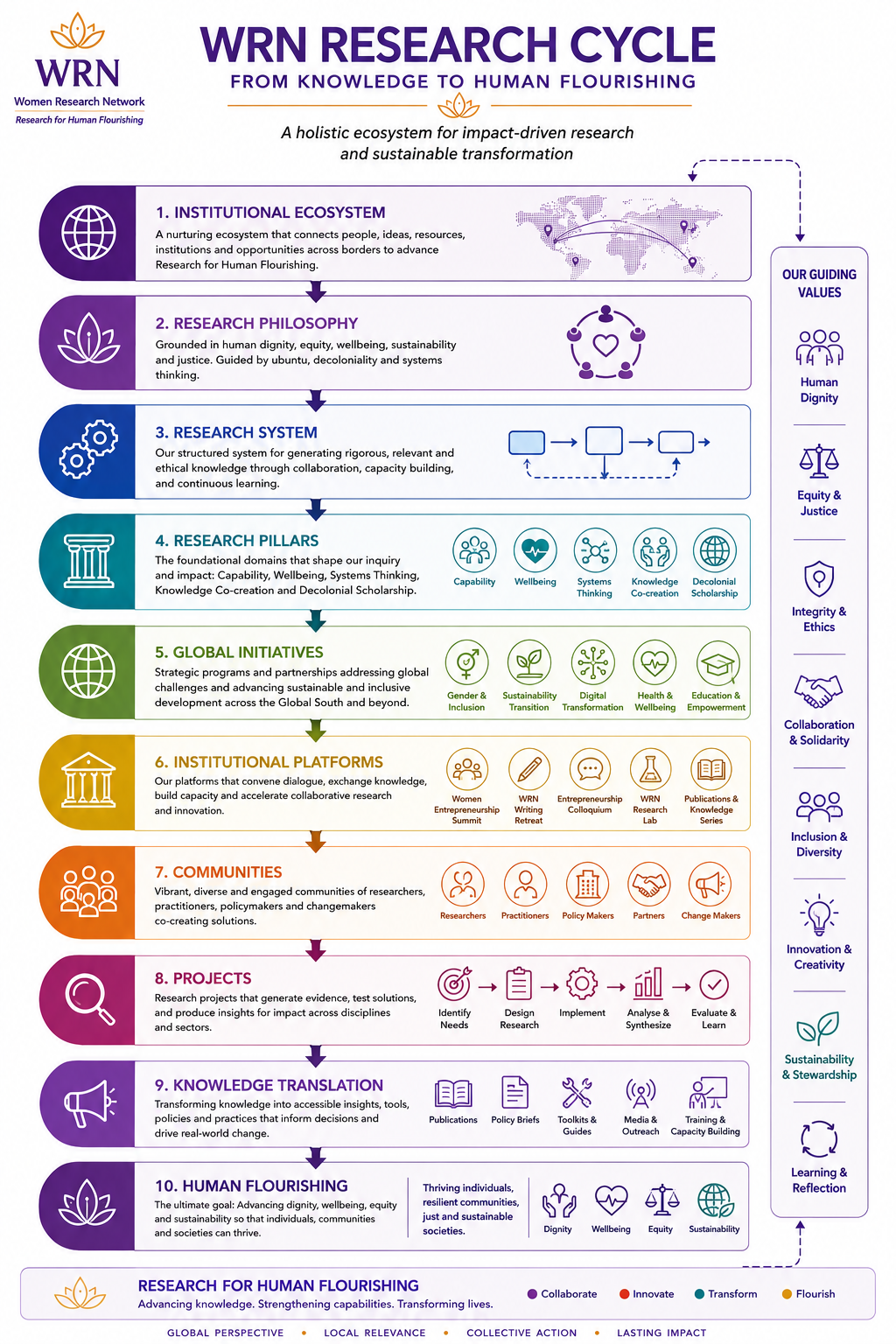
A detailed breakdown of the 10 steps in the WRN Research Cycle. Click to view full size.
The Building Blocks
The core elements that give this component its shape and power within our system.
1. Identify a Flourishing Challenge
Scan global & local context · Engage communities · Understand root causes · Frame the challenge. Listen to communities and partners to identify real-world challenges affecting the conditions for human flourishing.
2. Co-Design Research
Co-create research questions · Agree on methods & measures · Define roles & partnerships · Ensure ethics & equity. Collaborate with diverse partners to shape research that is relevant, inclusive and ethical.
3. Generate Knowledge
Collect & analyse data · Apply appropriate methodologies · Integrate multiple ways of knowing · Ensure quality & integrity. Conduct rigorous, innovative and contextually grounded research to generate high-quality knowledge.
4. Translate Evidence
Summarise key insights · Develop policy briefs, tools & resources · Communicate in inclusive ways · Build capacity for use. Make knowledge accessible, relevant and actionable for a range of audiences and sectors.
5. Influence Policy
Engage stakeholders · Advocate using evidence · Support policy dialogue · Contribute to strategies & programmes. Engage decision-makers and systems to inform policies, strategies and resource allocation.
6. Measure Flourishing
Track outcomes & indicators · Use mixed methods · Capture intended & unintended effects · Centre voices of communities. Assess the impact of interventions and policies on the conditions for human flourishing.
7. Generate New Questions
Reflect on learning · Identify new gaps & opportunities · Refine theory & approaches · Begin the cycle again. Use what we know and what we have learned to raise new questions for continued learning.
Principles That Guide Us
These commitments turn the The WRN Research Cycle from an idea into a working part of how we do research every day.
Human-Centred & Inclusive — communities are partners throughout, not subjects of study.
Co-creation & Partnership — knowledge is built with, not for, the people it serves.
Equity, Ethics & Justice — every stage upholds fairness, rights and ethical responsibility.
Contextual & Place-Based — research is rooted in the realities of specific people and places.
Adaptive & Iterative — the cycle learns and evolves at every turn.
Evidence-Informed & Action-Oriented — rigour and relevance are held together.
Sustainability & Long-Term Impact — outcomes are designed to endure.
Accountability & Transparency — we answer to the communities our research serves.
Continuous learning. Collective impact.
Knowledge that listens. Research that transforms. Action that flourishes.
A system that learns is a system that lasts. The Research Cycle keeps rigour, reflection and relevance growing together — turn by turn, stage by stage.
WRN Research Cycle · Figure 7.1
The Research Cycle sustains the whole system over time. It carries questions framed by the Flourishing Lens, drives them toward the flourishing of the Ecosystem Model, delivers change through the Flourishing Pathways, and loops the lessons back to begin again.
Explore the other components
Be Part of Something Greater
Join a global community committed to knowledge, compassion and transformation.