Home › Our System › Flourishing Ecosystem Model
Flourishing Ecosystem Model
Understanding the conditions for human flourishing
The Flourishing Ecosystem Model (FEM) is WRN's systems approach to research and impact. It recognises human flourishing as the ultimate purpose of knowledge and maps the dynamic interaction between capabilities, resources, institutions and systems that create the conditions for people to thrive.
Understanding the conditions for human flourishing
4
Interconnected layers
6
Dimensions of flourishing
What is the Flourishing Ecosystem Model?
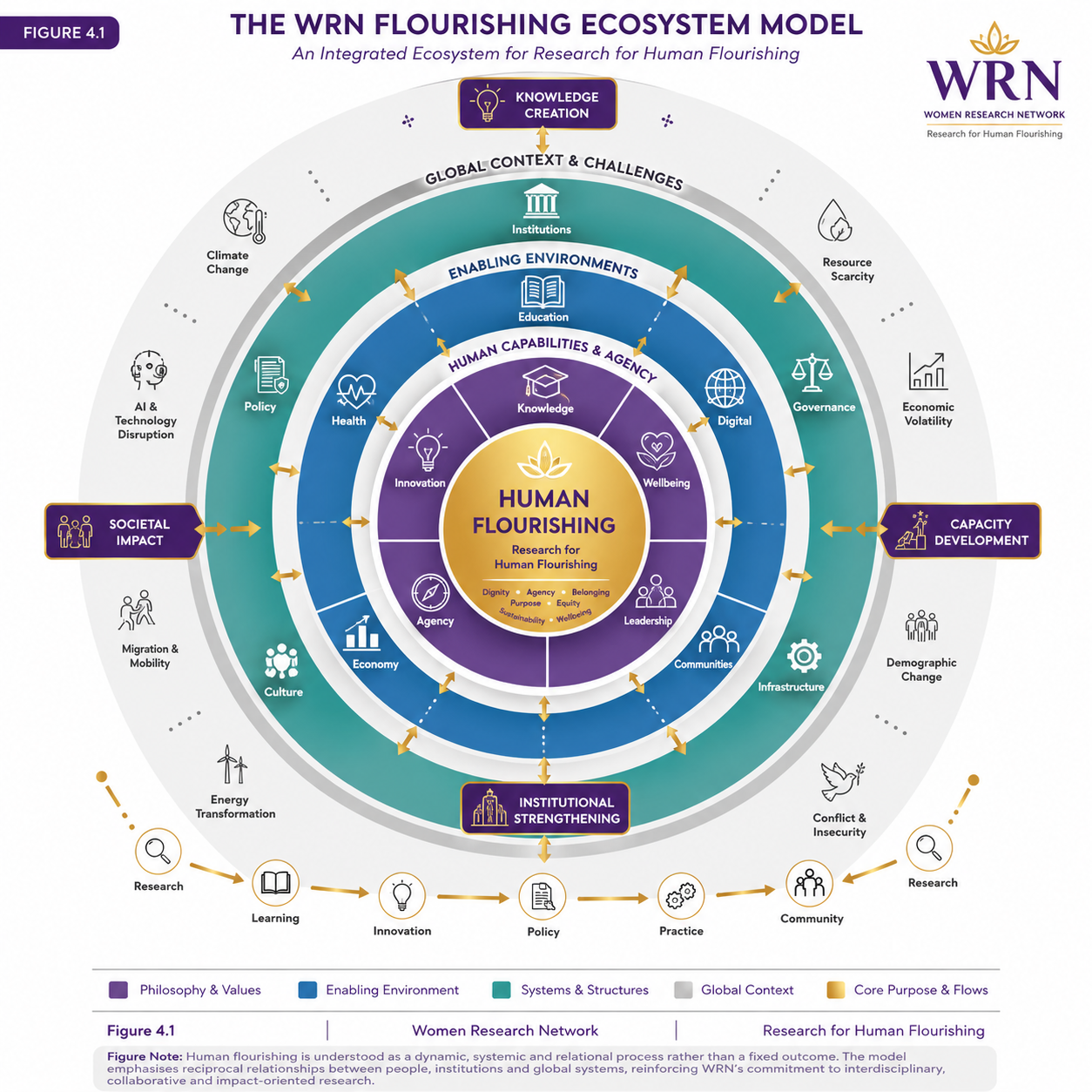
The FEM is built around four concentric layers. At the centre is the individual — their capabilities, health, education, economic agency, psychological wellbeing and sense of purpose. Around them sit the enabling resources that make capability real: finance, technology, energy, infrastructure and information. The third ring is institutions and actors — universities, governments, healthcare systems, schools, industry and communities — whose norms and structures either open or close doors. The outermost ring is the systems context: climate, economy, policy, culture, politics, digital transformation and globalisation.
All four layers are connected by a Knowledge Ecosystem that is co-created, shared, applied and continuously evolving. Knowledge flows in all directions — from communities to institutions, from systems to individuals — and is the medium through which change happens.
Human flourishing sits at the very heart of the model: health, wellbeing, dignity, opportunity, purpose and agency. These are interconnected and mutually reinforcing. Progress in one amplifies the others; neglect in one undermines the rest.
The Flourishing Ecosystem Model
 View full size
A holistic systems model of human flourishing. Click to view full size.
The Building Blocks
The core elements that give this component its shape and power within our system.
Individual Capabilities
Health, education, digital capability, economic capability, psychological wellbeing, skills, agency, leadership and purpose — the human capacities that enable people to lead lives they value.
Enabling Resources
Finance, technology, energy, infrastructure and information — the resources and assets that individuals and communities need to develop capabilities and pursue opportunities.
Institutions & Actors
Universities, governments, healthcare systems, schools, industry, NGOs, families and communities — organisations and structures that shape norms, provide services and either enable or constrain flourishing.
Systems Context
Climate, economy, policy, culture, politics, AI & digital transformation, environment and globalisation — the broad societal, environmental and political forces that influence the conditions for flourishing.
Knowledge Ecosystem
Knowledge flows across all levels — co-created, shared, applied and evolving. It connects individuals to institutions to systems, and is the medium through which learning and change travel.
Human Flourishing
At the centre: health, wellbeing, dignity, opportunity, purpose and agency. These are interconnected and mutually reinforcing — the ultimate outcome the entire ecosystem exists to advance.
Principles That Guide Us
These commitments turn the Flourishing Ecosystem Model from an idea into a working part of how we do research every day.
We treat flourishing as multi-dimensional — no single metric can capture its depth.
We recognise that individual capability depends on resources, institutions and systems — all four layers must be addressed.
We hold the whole picture in view, resisting reductive explanations of complex challenges.
We use the model as a compass, checking that our research is genuinely oriented toward flourishing.
We see knowledge as flowing in all directions — from communities upward, not only from experts downward.
The Scholarly Traditions Behind the Model
Capability Approach (Sen, Nussbaum)
Focus on expanding real freedoms and capabilities for individuals to lead lives they have reason to value.
Wellbeing Science (PERMA & Beyond)
Recognition of multidimensional wellbeing including physical, psychological, social and purposeful dimensions.
Systems Thinking
Understanding complex interdependencies, feedback loops and emergent outcomes across individuals, institutions and systems.
Gender & Social Justice
Addressing structural inequalities and ensuring inclusive participation and representation at every level.
Decolonial & Plural Knowledge
Valuing diverse ways of knowing and centring local, indigenous and community knowledge in research and action.
Sustainability Science
Embedding environmental sustainability and intergenerational responsibility into the foundations of knowledge.
Eight Principles That Animate the Model
Flourishing is Multidimensional
Knowledge is Co-created
Agency Drives Transformation
Institutions Enable Possibilities
Systems Shape Everything
Research Connects Everything
Equity & Inclusion Are Central
Sustainability for Future Generations
Research & Knowledge
Capacity Development
Institutional Strengthening
Policy & Practice Change
Community Transformation
Human Flourishing (continuous feedback loop)
To advance knowledge and action that creates the conditions for women and girls — and the communities they lead and serve — to flourish.
Flourishing is not one thing measured well, but many things held in balance — a living ecosystem of human dignity, shaped by capabilities, resources, institutions and the world around us.
WRN Flourishing Ecosystem Model
The Ecosystem Model is where our system begins. It tells us what flourishing looks like, which the Flourishing Lens then translates into how we frame and conduct research, the Change Pathway turns into real-world impact, and the Research Cycle keeps refining over time.
Explore the other components
Be Part of Something Greater
Join a global community committed to knowledge, compassion and transformation.