Home › Our System › Intellectual Foundations
Intellectual Foundations
The intellectual pillars that shape WRN's approach to knowledge
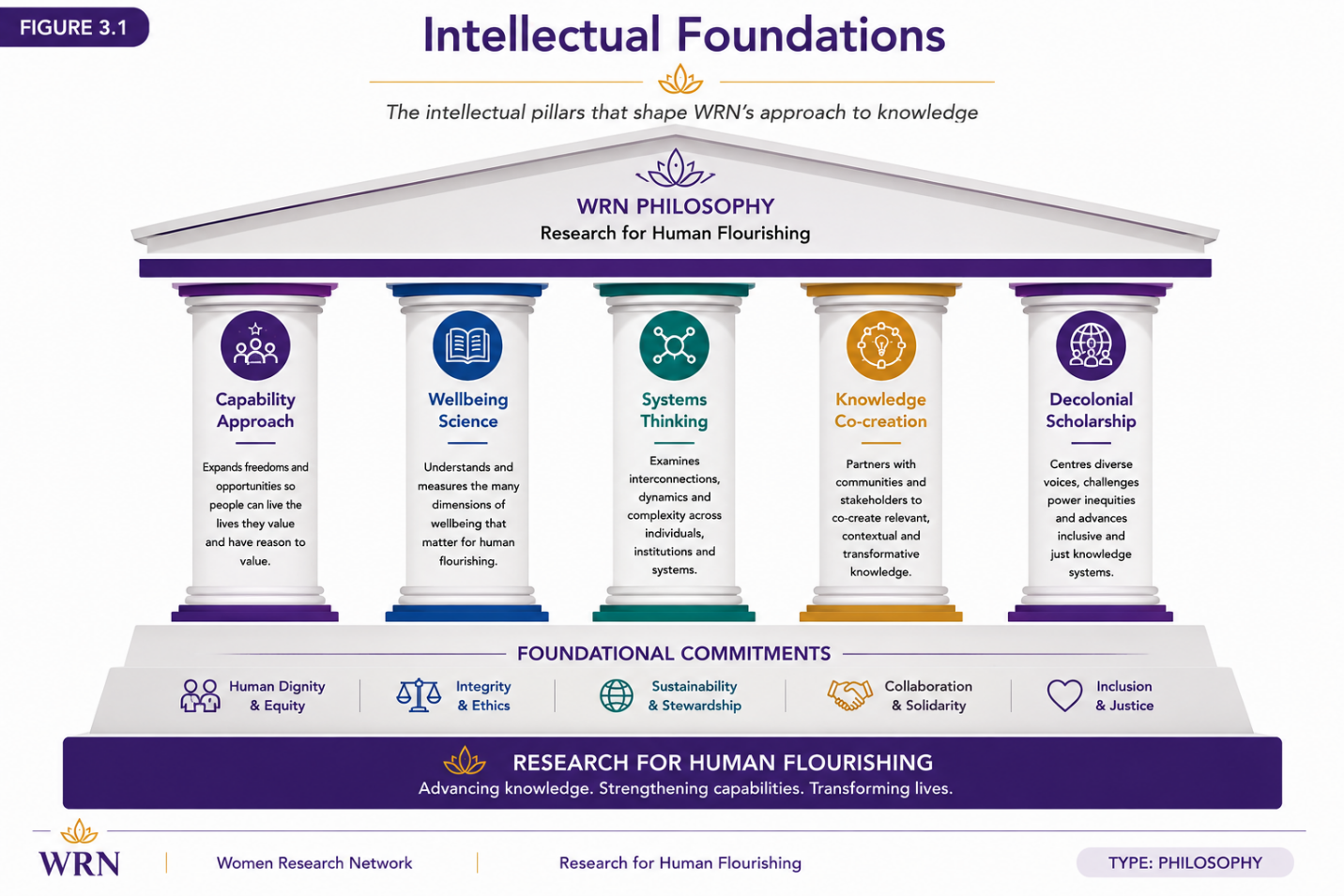
Our intellectual foundations are the five philosophical pillars on which WRN's entire research philosophy rests. Together they form the structure that holds our approach to knowledge — supporting a roof of purpose and grounded in non-negotiable commitments.
The intellectual pillars that shape WRN's approach to knowledge
5
Intellectual pillars
5
Foundational commitments
What is the Intellectual Foundations?
If our philosophy is the purpose of our work and our system is its structure, the intellectual foundations are its columns — the scholarly traditions we build from and the standards we will not compromise on.
Each pillar brings a distinct lens: the Capability Approach expands how we define freedom; Wellbeing Science deepens how we measure flourishing; Systems Thinking reveals the interconnections traditional research misses; Knowledge Co-creation ensures communities are authors not just subjects; and Decolonial Scholarship challenges whose knowledge counts.
Together these five pillars are held up by five foundational commitments — to Human Dignity & Equity, Integrity & Ethics, Sustainability & Stewardship, Collaboration & Solidarity, and Inclusion & Justice — which form the base of everything we build.
The Intellectual Foundations
 View full size
The five intellectual pillars that shape WRN's approach to knowledge. Click to view full size.
The Building Blocks
The core elements that give this component its shape and power within our system.
Capability Approach
Expands freedoms and opportunities so people can live the lives they value and have reason to value. We measure progress not in income alone but in real human agency.
Wellbeing Science
Understands and measures the many dimensions of wellbeing — physical, emotional, social, purposeful — that matter for human flourishing.
Systems Thinking
Examines interconnections, dynamics and complexity across individuals, institutions and systems — resisting reductive explanations of complex challenges.
Knowledge Co-creation
Partners with communities and stakeholders to co-create relevant, contextual and transformative knowledge — ensuring research reflects lived realities.
Decolonial Scholarship
Centres diverse voices, challenges power inequities and advances inclusive and just knowledge systems — questioning whose knowledge is privileged and why.
Principles That Guide Us
These commitments turn the Intellectual Foundations from an idea into a working part of how we do research every day.
We treat human agency and real freedoms as the measure of progress, not income metrics alone.
We measure wellbeing in its many dimensions — never reducing a person to a single indicator.
We trace interconnections rather than studying problems in isolation.
We build knowledge with communities, not simply about them.
We challenge whose knowledge counts and actively work to centre marginalised voices.
Human Dignity & Equity
Integrity & Ethics
Sustainability & Stewardship
Collaboration & Solidarity
Inclusion & Justice
Research for Human Flourishing
Advancing knowledge. Strengthening capabilities. Transforming lives.
Research for Human Flourishing must stand on intellectual foundations that are rigorous, plural, inclusive and committed to justice.
WRN Research Philosophy · Figure 3.1
These five pillars uphold the whole system. They give the Flourishing Lens its analytical standards, the Research Cycle its methodological discipline and the Change Pathway its accountability — ensuring quality and justice at every stage of our work.
Explore the other components
Be Part of Something Greater
Join a global community committed to knowledge, compassion and transformation.